The Expertise Paradox: The More You Know, the More You Question
Spend time with senior consultants, and you’ll notice something unexpected. They don’t carry themselves like people who have it all figured out. If anything, they often feel like they’re back at square one—again and again. That feeling isn’t insecurity. It’s awareness.
The deeper their experience runs, the more clearly they see just how layered, interconnected, and unpredictable modern business has become. What looked simple ten years ago now feels like a moving target. Markets shift overnight. Assumptions expire faster than strategy decks.
So instead of clinging to what they already know, top consultants build their identity around staying in motion. Learning isn’t something they schedule—it’s how they operate. It’s the difference between playing the game and staying in the game.
This article dives into that mindset. Not just the psychology behind it, but the real value it creates—for both consultants and the clients who rely on them.
The Reverse Dunning–Kruger Effect and Intellectual Humility
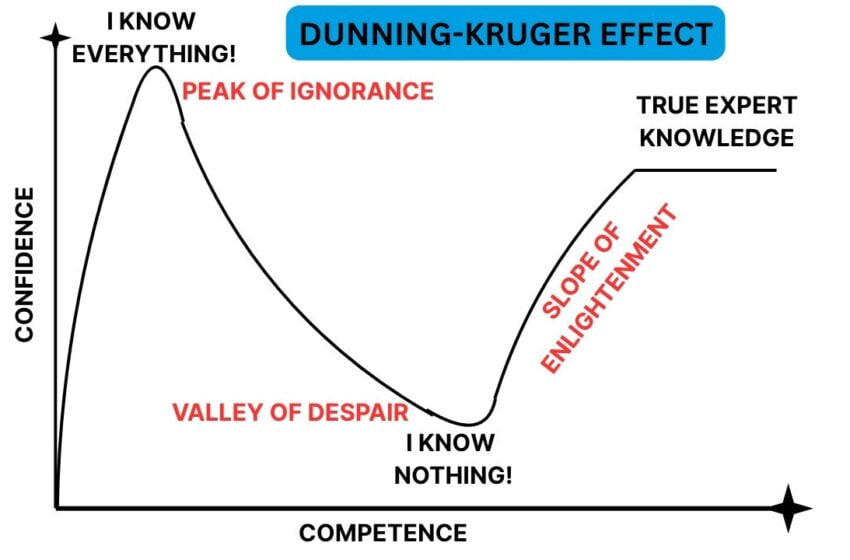
There’s a well-known psychological pattern that explains this dynamic: the Dunning–Kruger Effect. Early in a career, confidence tends to run high—often higher than it should. Limited exposure creates the illusion of clarity. But as experience deepens, something flips.
Experts don’t feel more certain. They feel more responsible. They see the trade-offs, the second-order effects, the hidden variables most people miss. That broader perspective naturally introduces doubt—not the paralyzing kind, but the kind that sharpens judgment.
In consulting, that kind of doubt is a feature, not a flaw. It pushes professionals to test assumptions, challenge easy answers, and stay intellectually honest. Continuous development serves as the bridge between what they know and what they might be missing. And that bridge is where better decisions get built.
Blind Confidence vs. Data-Driven Confidence
Not all confidence is created equal. Less experienced consultants often rely on "Blind confidence". They connect a few dots, recognize a familiar pattern, and move quickly toward conclusions. It can look decisive. Sometimes, it is even impressive. But it’s fragile.
Experienced consultants operate differently. Their confidence is earned through friction—data, analysis, iteration, and sometimes being wrong before getting it right. They don’t rush to certainty. They build toward it.
This is what turns confidence from a gut feeling into something you can stand on. And it’s exactly why continuous learning matters. It keeps the tools sharp, the thinking current, and the blind spots visible.
The Quiet Power of Intellectual Humility
Intellectual humility acts as a protective shield, preventing consultants from falling into the trap of professional arrogance and impulsive decision-making that can harm client outcomes. It allows consulting leaders to remain open to alternative perspectives and new interpretations that may challenge prior assumptions.
Research from Stanford University on the concept of the “Beginner’s Mind” highlights how adopting this mindset enhances innovative thinking. It enables experts to notice overlooked details and ask questions that lead to breakthrough solutions. In this context, continuous professional development is essential for renewing strategic thinking and preventing large-scale projects from stagnating.
The Rapid Evolution of Data and Business Models
The consulting landscape today doesn’t reward static expertise. Artificial intelligence, digital ecosystems, and rapidly evolving business models have shortened the shelf life of knowledge. What worked last year can quietly become irrelevant this year.
Staying current is no longer about professional pride. It’s about survival.
Continuous development, in this context, ceases to be a competitive edge and becomes basic infrastructure. It keeps consultants aligned with how the world actually works—not how it used to work. And that alignment is what clients are really paying for.
From Information to Insight: The Expert’s Learning Advantage
Modern organizations don’t suffer from a lack of data. They drown in it. The real differentiator isn’t access to information—it’s the ability to interpret it. To cut through the noise and find the signal that actually matters.
This is where expert consultants earn their seat at the table.
They don’t just collect inputs. They translate them. They connect dots that others don’t even see. They turn scattered data into a clear direction.
That capability doesn’t happen by accident. It’s built through deliberate learning—frameworks, models, and exposure to diverse situations that stretch their thinking.
Over time, that learning compounds. And what emerges isn’t just knowledge. It’s judgment.
The Impact of Rapid Learning Strategies on Consulting Value
The financial and professional value of a consulting hour is directly tied to the depth and relevance of the consultant’s knowledge at the moment advice is delivered. Rapid and focused learning strategies equip experts with cutting-edge tools and forward-looking perspectives that often exceed client expectations.
This proactive approach significantly enhances the quality of consulting outcomes and drives measurable performance improvements. Consequently, continuous professional development increases the client’s return on investment and justifies the premium value of consulting services, creating a relationship built on sustained mutual benefit.
Professional Mastery and the Rise of “Magnetic Authority”
The long journey of learning and exploration ultimately leads to professional mastery. This distinguished status positions the consultant as a trusted destination for clients seeking excellence, leadership, and institutional confidence. Discerning clients recognize that they are not merely purchasing solutions, but a way of thinking and a structured approach to solving complex problems.
Within this strategic framework, continuous professional development plays a central role in refining this intellectual methodology—transforming the consultant into a credible authority with a “magnetic presence” that naturally attracts high-quality opportunities and fosters long-term loyalty.
Learn Out Loud: Turning Your Growth Into a Reputation Engine
There’s a quiet shift happening in how credibility gets built. Consultants are no longer waiting years to “arrive” before they share what they know. Instead, they’re documenting the journey in real time—thinking out loud, publishing insights, and letting others see the work behind the work.
This “build in public” approach does something traditional resumes can’t. It shows how you think.
When you share your process—how you break down problems, challenge assumptions, and connect ideas—clients don’t just see outcomes. They see judgment in motion. That kind of visibility builds trust faster than polished credentials ever could.
Continuous learning becomes more than personal growth. It turns into raw material for influence. Every article, every case reflection, every insight you publish becomes a signal not just of knowledge, but of consistency, curiosity, and leadership in your space.
When Pressure Hits: Learning Becomes Your Safety Net
Crises have a way of exposing the difference between experience and readiness. When markets swing or uncertainty spikes, there’s no playbook that fits perfectly. Consultants are expected to respond in real time, often with incomplete information and high stakes.
This is where continuous learning proves its worth.
Consultants who actively expand their knowledge base don’t rely on a single perspective. They draw from a wide range of scenarios, industries, and global patterns. That mental diversity gives them options. And in a crisis, options are everything.
Instead of reacting late, they anticipate earlier. Instead of defaulting to safe answers, they explore smarter ones.
Ongoing development acts like a mental toolkit that keeps evolving. It allows consultants to navigate chaos with a level of clarity that feels almost counterintuitive. Less guesswork. More grounded decisions. And ultimately, better outcomes for the organizations counting on them.
If you strip it down, the difference between stagnant and high-impact consultants comes down to how they learn. Here’s how that contrast plays out in real-world performance:
|
Professional Metric |
Limited Learning (Relying Only on Past Experience) |
Deep & Continuous Learning (Integrating Experience with Modern Research) |
|
Success Rate in Complex Projects |
Low (struggles to adapt solutions to new variables) |
Very High (demonstrates agility in real-time strategy adjustment) |
|
Crisis Anticipation قدرة |
Weak (reactive after the crisis occurs) |
Proactive (predicts risks based on modern data analysis) |
|
Value Delivered to Clients |
Conventional, repetitive solutions |
Innovative, tailored solutions with sustainable competitive advantage |
The Pitfalls of the “Illusion of Expertise”
Mid-career is where many consultants quietly plateau. Not because they lack ability, but because they start believing they’ve seen enough. This is what you might call the illusion of expertise. It feels like confidence, but it slowly limits perspective. It shows up in subtle ways.
You recognize a pattern and assume it’s the same problem. You lean on what worked before without fully re-examining the context. You stop seeking new inputs because your past success feels like proof you’re on the right track. Over time, that mindset narrows your field of vision.
Avoiding it requires intention. And honesty. Here are the most common pitfalls to watch for:
- “I’ve seen this before,” thinking: Familiarity can trigger confirmation bias. You start filtering new problems through old lenses and miss what’s actually different this time.
- Intellectual autopilot: Once recognition and seniority kick in, it’s easy to reduce learning effort. Reading slows down. Curiosity fades. And without noticing, your knowledge starts aging.
- Over-indexing on technical skill: Technical depth matters, but it’s not enough. Ignoring communication, emotional intelligence, and client dynamics creates blind spots that can derail even the strongest strategies.

Stay Hungry, Stay Sharp
The best consultants don’t protect their identity as “experts.” They protect their ability to keep evolving. Feeling like a beginner isn’t a sign you’re falling behind. It’s a sign you’re paying attention.
Because the moment everything feels obvious is usually the moment growth stops.
In a world that keeps shifting under your feet, the real advantage belongs to those who stay curious enough to question themselves—and disciplined enough to keep learning anyway.
That’s what keeps your thinking fresh. Your judgment is sharp. And your work impossible to ignore.
FAQs
1. Does constantly feeling the need to learn mean I’m not truly an expert?
Actually, it’s the opposite. That awareness signals depth. It means you understand the complexity of your field and refuse to settle for surface-level thinking.
2. How can I balance learning time with client work?
Apply the 80/20 rule. Think in ratios. Dedicate around 20% of your time to learning so the remaining 80% becomes sharper, faster, and more valuable. It’s not time away from work—it’s what makes your work better.
3. What is the fastest way to learn a new consulting skill?
Teach it. Write about it. Explain it out loud. The moment you try to articulate an idea, any gaps in your understanding become obvious—and that’s where real learning happens.
This article was prepared by trainer Dr. Mohammed Al Rashid, MMB Certified Coach.
Ads space
Latest Articles




Stay up-to-date with the latest
Be aware of the latest articles, resources and upcoming courses