
Beyond the Ask: How the 5 Whys Help You Hear What Clients Really Mean
As a seasoned consultant, you’ve probably seen this movie before. A client abandons their shopping cart. Or they buy—and then circle back, frustrated and disappointed. The first instinct is almost always the same: It must be the price.
But is it?
According to Bain & Company, nearly 80% of companies believe they deliver a great customer experience, while only about 8% of customers agree. That gap isn’t a rounding error—it’s a flashing red warning light. It tells us one thing loud and clear: most organizations think they understand their customers, but they’re listening to the wrong signal.
To close that gap, quality pioneer Sakichi Toyoda gave us a deceptively simple tool: the 5 Whys. It’s not flashy. It’s not complex. But it cuts through noise like a hot knife through butter.
If you’re ready to stop treating symptoms and start diagnosing the real issue, keep reading.
Why Do We Fail to Understand the “Root” of the Client’s Problem?
Let’s call it what it is: understanding what a client truly needs is hard. Even for experienced professionals. Especially for skilled professionals.
How often have you walked away from a project feeling like you put a perfect bandage on the wrong wound?
That’s the Need Gap—the space between what the client asks for and what they actually need.
Defining the Problem: “The Need Gap”
At its core, the issue lies in the difference between what the client asks for and what they actually need. How many times have you had a client come to you asking for a ready-made solution, saying things like, “I want a new website” or “I want an innovative app”?
But is that the real need? In most cases, the request is merely a manifestation of the problem, while the actual need may be to improve efficiency or increase sales. Working on the surface-level request almost guarantees failure.
Root Causes
Why do we fall into this trap—even as experienced consultants? The reasons are simple, familiar, and rooted in everyday work realities:
- The desire for quick execution: As a consultant, you may want to close the project and mark it as “completed” as fast as possible. This encourages you to accept the client’s surface-level solution without exploring the root causes.
- The client’s misplaced confidence in their solution: The client is an expert in their field, but not in problem diagnosis. As a result, time is wasted addressing their proposed solution instead of identifying the core issue.
- Fear of asking obvious questions: Do you hesitate to ask the simple question “Why?” out of fear it might sound naïve or unprofessional? This hesitation is the biggest barrier between you and the root cause.
What Are the Consequences—and Are the Results Satisfying?
When solutions are built on shaky assumptions, the fallout is predictable:
- Wasted money and effort: Budgets are spent on technical solutions that are never fully used or fail to achieve their intended goals.
- Loss of credibility: The client’s belief in you as a trusted partner weakens when your solutions fail to deliver real value.
- Ineffective solutions: The result is products or services that address only symptoms, leaving the client frustrated and reducing the chances of future collaboration.
"What is the “Need Gap”? The problem is that the client describes the symptom (e.g., “we need a faster website”) as a request, while the real issue (the need) may be poor user experience. Failing to identify the root cause results in wasted resources and a loss of client trust".

The 5 Whys: Simple Question, Serious Power
So how do you cross that gap?
Enter the 5 Whys—a tool that doesn’t decorate the problem, but dismantles it.
Why One Question Changes Everything
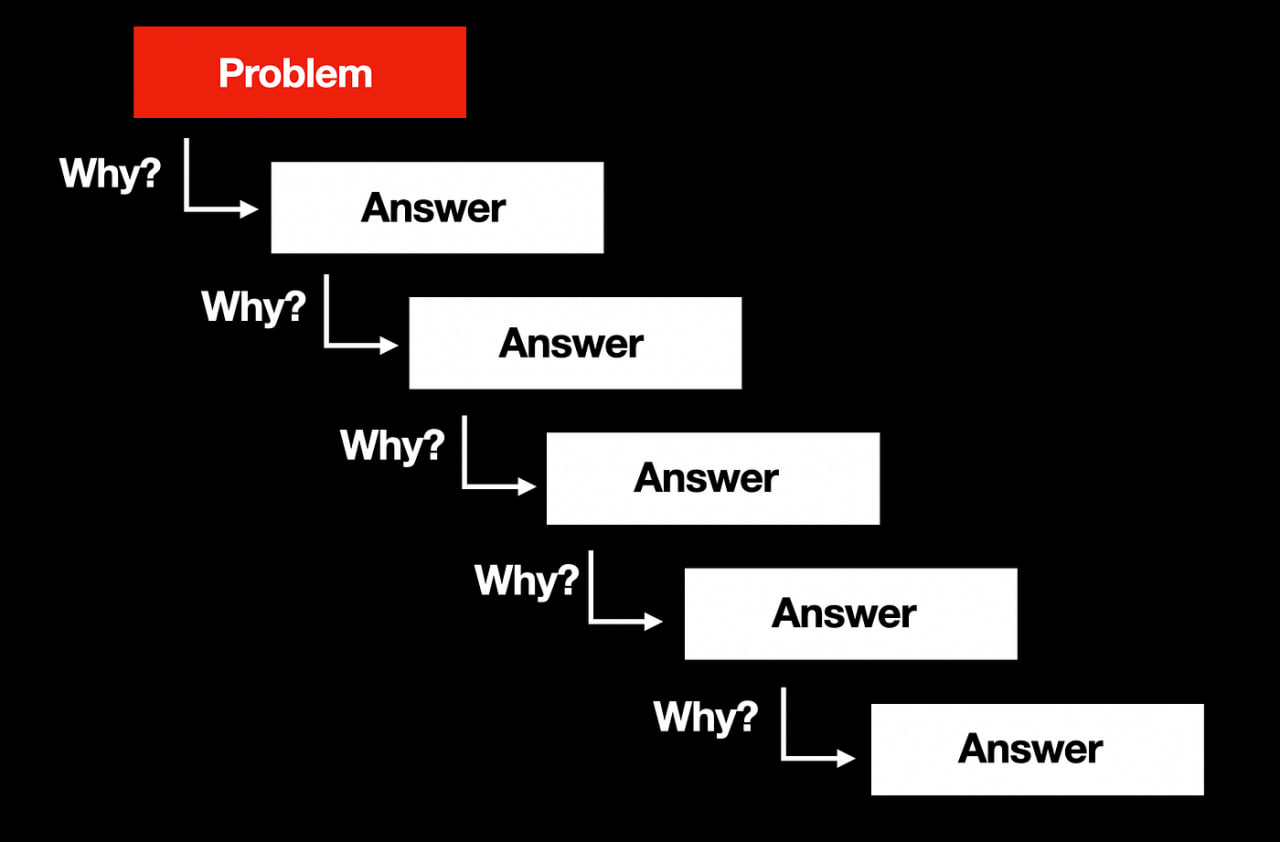
At its core, the 5 Whys is part of Root Cause Analysis (RCA). The idea is straightforward: keep asking “Why?”—typically five times—until you reach the underlying driver of the problem.
This isn’t an interrogation. Think of it as a guided descent, moving from what’s visible to what’s actually pulling the strings behind the scenes.
Why This Method Works: A Lesson from Toyota
Skeptical? Fair.
The 5 Whys wasn’t born in a conference room. It was forged on the factory floors of Toyota, created by founder Sakichi Toyoda, and embedded into the Toyota Production System.
Its original purpose was ruthless in its clarity: eliminate defects at the source. If it can uncover the root cause behind a halted production line costing millions per hour, it can certainly expose the real need behind a vague client request.
Why “Five” Whys—and Not Three or Ten?
There’s no magic in the number five. It’s just practical wisdom.
Toyota engineers found that:
Fewer than five “Whys” often stop at a secondary cause.
More than five tends to spiral into irrelevant detail.
Five strikes the sweet spot—deep enough to reach the core, focused enough to stay useful.
"What is the 5 Whys technique? It is a simple Root Cause Analysis (RCA) tool developed by Toyota. Instead of accepting surface problems, you repeatedly ask “Why?” (typically five times) until you reach the fundamental cause that triggered the problem in the first place".
Turning Insight into Impact: How to Apply the 5 Whys
This is where theory meets execution. Used correctly, the 5 Whys doesn’t just clarify—it prevents waste. Think of it like a physician diagnosing before prescribing. Precision is the difference between expertise and guesswork.
1. Clearly Define the Problem (the Surface Request)
Forget vague complaints. Define the surface issue clearly and measurably.
Instead of:
“We have a sales problem.”
Try:
“The sales team misses over 50% of scheduled client appointments.”
Clarity isn’t optional—it’s your first credibility signal.
2. Ask the First “Why?” (and Get the First Answer)
Now open the investigation:
Why does the sales team miss so many appointments?
You might hear:
“Because entering data into the CRM takes too long.”
Resist the urge to jump to solutions. This is just the outer layer.
3. Keep Digging—One Layer at a Time
Take the answer and ask “Why?” again.
Then again.
And again.
It’s like peeling an onion—each layer gets you closer to what’s actually driving the behavior. This disciplined curiosity is what separates surface-level work from real consulting.
4. Reaching the “Root Cause” (When Do We Stop?)
How do you know you’ve reached the end? You stop when the answer is no longer something you can meaningfully ask “Why?” about, but rather a fundamental policy, system, or structural barrier.
The fifth answer might be: “Because there is no onboarding training for new employees on the CRM system.”
This is the root cause—the underlying driver fueling all the other problems.
5. Propose the “Root Solution” (Countermeasure)
You can’t leave the client alone with the problem. Once the root cause is identified, you must propose a solution that prevents recurrence.
Instead of merely fixing the issue, you’re building a system for the future. The root solution might be:
“Develop a mandatory, structured onboarding training program for new employees on the CRM system, with monthly updates.”
This kind of solution demonstrates true trustworthiness and elevates you from consultant to strategic partner.
" How do you apply the 5 Whys technique?
- Clearly define the problem (the surface request).
- Ask, “Why did this happen?”
- Use each answer as the basis for the next “Why?”
- Repeat until you reach an indivisible cause (the root cause).
- Design a solution for that root cause—not for the surface request.

From Request to Reality: A Hands-On 5 Whys Walkthrough
Nothing proves the value of a tool like seeing it at work. We’ve covered the theory—now it’s time to put some skin in the game. This example is the backbone of the article, designed to show how a deceptively simple method can uncover insights most teams miss. Ready to see the 5 Whys in action?
The Surface Problem (The Request): “I want a new social media advertising campaign.”
This is a classic opening move. The client arrives with a solution already locked and loaded, convinced that spending more on ads will fix declining sales. Your real job, however, is to hit pause and ask the uncomfortable question: Is advertising the cure—or just a quick fix for a deeper problem?
Why #1? “Because our sales are low.”
Step one: Ask the client, “Why do you want a new advertising campaign?”
Their answer: “Simply because our sales are low.”
(At this point, we’re still hovering at 30,000 feet. This is the symptom, not the diagnosis.)
Why #2? “Because website traffic is low.”
Step two: Your follow-up, “Okay—why are your sales low?”
Answer: “Because traffic to our website is low, not enough people are seeing our products.”
(We’ve now moved one level deeper, into a marketing-related issue.)
Why #3? “Because our Google ranking is poor.”
Step three: Ask, “Why is your website traffic low?”
Answer: “Because our ranking on Google is poor, and we rarely appear on the first page.”
(Here’s the pivot point. The issue is no longer ads—it’s visibility. Specifically, organic visibility.)
Why #4? “Because our content is outdated and off-target.”
Step four: Dig deeper, “Why is your Google ranking poor?”
Answer: “Because our content is very outdated and doesn’t target the right keywords customers are searching for. We don’t have a dedicated content team.”
(Now we’re closing in. This isn’t a traffic problem—it’s a capability gap.)
Why #5 (Root Cause): “Because we don’t have a clear SEO strategy.”
Step five: Final push, “Why doesn’t your content target the right keywords, and why don’t you have a specialized team?”
Answer: “Honestly? We don’t have a clear SEO strategy or a budget allocated for it.”
That’s the moment of truth. You’ve hit bedrock.
The Outcome (The Root Solution): The problem isn’t “advertising”—it’s the absence of an SEO strategy.
Here’s the reveal: the problem was never advertising.
The real issue is the absence of a structured, long-term content and SEO strategy. Pouring money into ads would only drive traffic to weak foundations—like throwing a Super Bowl-sized crowd into an unfinished stadium.
The root solution is clear:
Stop spending on ads that amplify the problem. Start building a strong, intentional SEO and content strategy that earns traffic instead of renting it.
This is where your role changes. You’re no longer taking orders—you’re shaping outcomes. You move from executor to strategic partner, solving the right problem instead of the loudest one.
"Example of the 5 Whys technique:
- Request: We need an ad campaign.
- Why? Sales are low.
- Why? Website traffic is low.
- Why? Our Google ranking is poor.
- Why? We don’t have an SEO strategy. (Root cause)
Solution: Build an SEO strategy—not just an ad campaign".
Common Mistakes When Applying the 5 Whys
Despite its simplicity, the 5 Whys technique—like any powerful tool—requires disciplined practice to stay on track. Knowing what not to do is just as important as knowing what to do. Below are the most common mistakes that analysts and consultants make, so your expertise is clearly evident in every session.
1. Stopping Too Early (Not Reaching the 5 Whys)
Many teams quit after the second or third “Why” because the answer sounds reasonable. That’s where most analyses fail.
The goal isn’t to reach five questions—it’s to reach a point where no meaningful “Why?” remains. Don’t stop when it feels comfortable. Stop when it’s complete.
2. Turning the Session into a Blame Game (Pointing Fingers)
The 5 Whys is about process, not people.
If an answer points to someone’s mistake, ask again:
“Why did the system allow this to happen?”
“What safeguard was missing?”
Focusing on systems—not individuals—is what signals real professionalism.
3. Relying on Guesswork Instead of Data (When Possible)
Whenever possible, the early answers should be grounded in data rather than opinions.
If someone says, “I think this is why,” follow up with:
“How do we know?”
“What evidence supports this?”
Data is the difference between insight and intuition.
4. Confusing “Contributing Causes” with the “Root Cause”
This mistake is subtle but critical. Contributing causes are factors that worsen the problem (e.g., “we were busy”). The root cause is the underlying reason that, if eliminated, prevents the problem from recurring.
The root solution—derived from the fifth answer—must establish a measure that stops the problem at its source.
"Most common mistakes when applying the 5 Whys:
- Stopping too early: settling for the second or third cause (the symptom).
- Blame: asking “Who’s at fault?” instead of “Why did the system fail?”
- Guesswork: basing analysis on opinions rather than facts and data".
Stop Fixing Symptoms. Start Solving Problems
Most client failures don’t come from bad execution—they come from answering the wrong question.
The Need Gap is where budgets disappear, and trust erodes. The 5 Whys closes that gap with disciplined curiosity and proven logic—straight from Toyota’s playbook.
Don’t be an order taker. Be the person who asks the question that changes everything.
Use the 5 Whys in your next client conversation—and watch how the quality of your solutions (and your credibility) instantly level up.
This article was prepared by trainer Majed Bin Afif, MMB Certified Coach.
Ads space
Latest Articles






Stay up-to-date with the latest
Be aware of the latest articles, resources and upcoming courses